
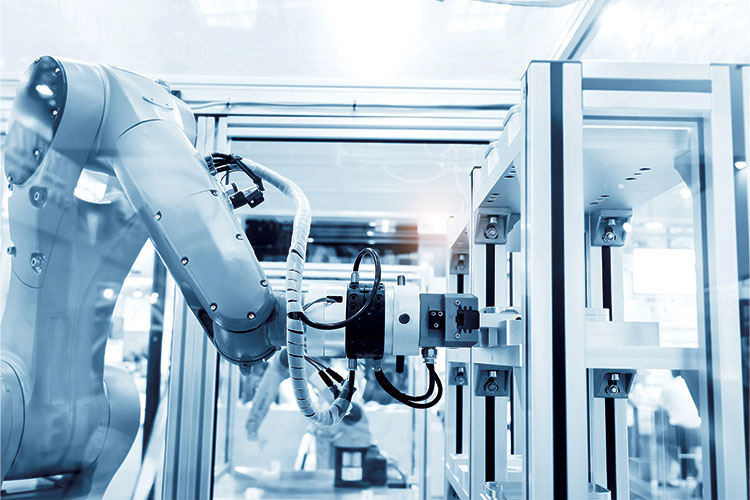
Lanner EAI-I351: Server-Grade Edge AI for Autonomous Machines
In the fast-paced world of industrial automation and robotics, processing power at the network’s edge is paramount. The new Lanner EAI-I351 platform answers this call, delivering unprecedented computational muscle for autonomous mobile robots (AMRs) and smart industrial systems. Built around the groundbreaking NVIDIA Jetson Thor module, this system redefines what’s possible for on-device AI, from complex navigation to running localized generative models.
Unmatched Performance with NVIDIA’s Blackwell Architecture
At the heart of the EAI-I351 lies the NVIDIA Jetson Thor SoM. Leveraging the new Blackwell GPU architecture, it achieves up to 2,070 FP4 TFLOPS of AI performance within a 130W power budget. This represents a monumental leap. Compared to the prior Jetson AGX Orin, it offers roughly 7.5x more AI compute and 3.5x better energy efficiency. A dedicated transformer engine is key, optimized for multi-modal generative AI and large language models (LLMs) at the edge.
Author’s Insight: This performance shift is critical. It moves edge computing from simple perception tasks to advanced reasoning and generation, enabling truly intelligent, autonomous decision-making without constant cloud reliance.
Specialized Accelerators for Real-Time Vision Tasks
Beyond raw GPU power, effective automation requires specialized processing. The platform integrates a suite of accelerators including a third-generation Programmable Vision Accelerator (PVA), optical flow engines, and dual codecs. Therefore, it handles demanding visual workloads like simultaneous localization and mapping (SLAM) and 3D reconstruction with remarkably low latency, which is essential for safe operation.
Robust Connectivity for Sensor-Rich Environments
Modern autonomous systems are defined by their sensors. The EAI-I351 is engineered accordingly. It provides eight GMSL2 inputs for high-resolution automotive cameras, enabling comprehensive sensor fusion. For network connectivity, flexible I/O includes high-speed QSFP28 and 5GbE RJ45 ports. Moreover, four USB 3.2 ports and four DIO channels allow for seamless integration with a wide array of industrial peripherals and legacy control systems.
Built for Demanding Industrial Deployment
Factory floors and outdoor applications are unforgiving. This platform is built to endure, supporting an operating temperature range from -25°C to 70°C. For continuous data flow, two M.2 slots support Wi-Fi and 5G/LTE modules. As a result, it ensures reliable cloud-to-edge communication for fleet management, telemetry, and over-the-air updates in rugged settings.
Streamlined Development with Full NVIDIA AI Stack
Hardware alone isn’t enough. The EAI-I351 is fully optimized for NVIDIA’s comprehensive software ecosystem. This includes NVIDIA Isaac for robot simulation, NVIDIA Metropolis for vision AI, and NVIDIA Holoscan for sensor processing pipelines. Consequently, developers can leverage proven frameworks to accelerate time-to-market for advanced agentic AI workflows, such as intelligent video analytics.
Practical Solutions for Automation Challenges
This platform enables transformative solutions across industry verticals. In logistics, it can power AMRs that dynamically replan routes using on-board LLMs. For industrial automation, it serves as the central AI brain for autonomous guided vehicles (AGVs) in smart factories. Furthermore, it acts as a powerful edge server for real-time quality inspection and predictive maintenance analytics on the production line.
Author’s Comment: The convergence of server-class AI, rugged design, and rich I/O in a single platform like the EAI-I351 simplifies the architecture for next-generation automation. It allows engineers to focus on creating innovative applications rather than solving fundamental hardware integration challenges.
Frequently Asked Questions (FAQs)
Q1: What makes the EAI-I351 suitable for harsh industrial environments?
The platform supports a wide operating temperature range (-25°C to 70°C) and is built with a rugged design, making it ideal for factories, warehouses, and outdoor autonomous systems.
Q2: How does the Jetson Thor’s performance benefit edge AI applications?
Its massive AI compute (up to 2070 TFLOPS) and dedicated transformer engine allow it to run complex models like LLMs locally, reducing latency and bandwidth costs for real-time decision-making.
Q3: What camera connectivity does the platform offer?
It features eight GMSL2 deserializer inputs, providing direct, high-bandwidth connections for multiple automotive-grade or industrial cameras essential for perception and navigation.
Q4: Can it connect to existing factory network and control systems?
Yes. With high-speed Ethernet options (QSFP28, 5GbE) and digital I/O (DIO), it integrates seamlessly into existing industrial networks and can interface with PLCs and other legacy equipment.
Q5: What software tools are available for developers?
Developers can use the full NVIDIA AI stack, including Isaac, Metropolis, and Holoscan, which provide robust frameworks for robotics, vision AI, and sensor processing application development.

 No products in the cart.