
SmartRay’s AI Weld Inspection System: Redefining Automated Quality Control in Manufacturing
Introduction: A New Era for Precision Inspection
At the European Industrial AI Innovation Hub in Stuttgart, SmartRay showcased a significant advancement. The company unveiled its JOSY weld inspection system. This demonstration highlights a major step forward for industrial automation. Furthermore, it merges sophisticated 3D scanning with intelligent, self-programming software.
Core Technology and Strategic Collaboration
The system combines SmartRay’s JOSY hardware with advanced Tool Path Generation software. This software resulted from a partnership with Wandelbots and Grid Dynamics. Therefore, it creates a fully integrated and closed-loop workflow. This integration is crucial for modern control systems in smart factories.
Key Advantages for Automotive Production
This solution directly tackles efficiency challenges on the production line. It removes manual programming and the associated human errors. Moreover, it drastically cuts down on material scrap. The AI automatically creates inspection routines from digital CAD designs. As a result, automotive manufacturers gain a reliable and consistent quality assurance tool.
Operational Benefits and Process Integration
Factories implementing this system can expect multiple improvements. The technology allows for instant feasibility checks before physical production begins. In addition, it provides accurate cycle time estimations directly from the CAD model. This leads to faster project commissioning and eliminates weeks of manual robot programming. Consequently, data flows seamlessly from part design to final inspection with proven fault detection accuracy.
Expert Commentary on Closed-Loop Manufacturing
Bernd Lorösch, VP of the JOSY unit at SmartRay, emphasized the system’s role. He described it as a perfect model for closed-loop production processes. The high level of AI-based automation from design to production significantly boosts process efficiency for their customers. This approach is becoming the new standard in factory automation.
The Innovation Hub’s Role in Industrial AI
Spaces like the EY Innovation Hub are vital for technological adoption. They allow industrial companies to experience digital transformation firsthand. These hubs feature real-world demos and foster collaboration around emerging technologies. Therefore, they help manufacturers accelerate decision-making and co-create scalable solutions with industry leaders.
Author’s Insight: The Strategic Impact of AI in PLC and DCS Environments
From an industry perspective, this development transcends a simple product update. It represents a foundational shift towards autonomous manufacturing systems. The true innovation lies in using AI to bridge the gap between design (CAD) and execution (robot path), a traditionally manual and error-prone interface. In my analysis, while the 100% fault detection claim is impressive, the greater value is predictive. Systems like JOSY can evolve to predict weld flaws based on process parameters, moving from detection to prevention. However, integration with existing PLC and DCS control systems will be a critical success factor for widespread adoption.
Practical Solution Scenario: Battery Tray Manufacturing
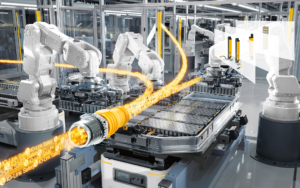
Challenge: An electric vehicle manufacturer needs to inspect over 500 laser welds on each battery tray for safety compliance. Manual programming is slow, and inconsistent inspections risk recalls.
Solution: Implementing the JOSY system. The CAD model of the tray is loaded, and the AI automatically generates the optimal inspection path for the robot-mounted 3D sensor.
Outcome: Commissioning time drops from weeks to days. Every weld is inspected with consistent accuracy, flaw data is logged digitally, and any defect immediately halts the line for correction. This enhances safety, reduces cost, and ensures traceability.
Frequently Asked Questions (FAQs)
Q: How does this AI system differ from traditional automated inspection?
A: Traditional systems require extensive manual programming of inspection paths. This AI generates the optimal path automatically from the CAD file, saving time and eliminating programming expertise as a bottleneck.
Q: Can this technology integrate with existing factory robots and control systems?
A: Yes, developed with Wandelbots for easy robot integration, it is designed to work alongside major PLC and DCS platforms, focusing on enhancing the existing automation ecosystem rather than replacing it.
Q: What is the biggest barrier to adoption for such advanced systems?
A: Beyond cost, the main challenge is often data readiness and cultural shift. Companies need well-structured digital CAD models and must trust AI-driven processes, which requires change management and upskilling.
Q: Is the “100% fault detection” claim realistic in a complex factory environment?
A> It refers to the system’s ability to execute the programmed inspection routine without missing a designated check point. Environmental factors like part positioning and cleanliness still require proper management to ensure reliability.
Q: What’s the next likely evolution for such inspection systems?
A: The trend is moving from detection to prediction. Future systems will likely analyze process data (e.g., heat, speed) in real-time to predict a weld’s integrity before it’s even inspected, enabling true predictive quality control.
 No products in the cart.